

Tanzania, like many other national governments, commemorates the World Sight Day while implementing its government-led Covid-19 campaign by bringing together various eye care stakeholders and implementation partners. World Sight Day is a global awareness day observed every year on the second Thursday in October to draw attention to vision impairment, including blindness. This year’s World Sight Day theme is “Love Your Eyes”. Enhancing community-led monitoring (CLM) approach to strengthen eye healthcare systems is therefore imperative. Placing communities and patients at the center of the eye care responsive health systems is critical to strengthening eye healthcare systems.
Strengthening eye healthcare systems may request adequate capacities in data demand and use through community-led monitoring approach, which is vital to improving vision care systems and services. Mactaggart, I (2014) claims that improving eye health in the community can only be done in partnership with the community itself. According to the 74th World Health Assembly(WHA), interventions that address the needs associated with uncorrected refractive error and un-operated cataract are among the most cost-effective and feasible health interventions available. WHA further reports that to meet these goals, all stakeholders, including governments, civil society, international organizations, intergovernmental organizations, and the WHO Secretariat, must collaborate in creative ways to serve the population’s eye care requirements. Uncorrected refractive error was the largest cause of global vision loss in 2020.
Globally, at least 2.2 billion people have a near or distance vision impairment due to uncorrected refractive error, unoperated cataract, age-related macular degeneration, glaucoma, diabetic retinopathy, corneal opacity, and trachoma, but most of these preventable cases have yet to be addressed. It is important to use the current data on the causes of vision impairment and blindness to inform public health policy recommendations.

Key issues in working with communities to improve their eye health.
Because each community is unique, and there may be special beliefs and customs that influence community members’ readiness to change their habits or behavior, improving eye health in the community can only be done in collaboration with the community itself, claims Mactaggart. In fact, there are many reasons as to why communities may at some point decide not to use eye health services, even when they are available due to certain constraints, including cultural factors. Essentially, any program’s success hinges on demonstrating respect for the community and including them in both the design and implementation of services. This is where the essence of using inclusive project cycle management in non-communicable diseases is considered fundamental in working with communities to improve eye health.
Mactaggart continues to claim that understanding potential barriers to uptake of services is a key way that may contribute to improving eye health at the community level. Therefore, it is important to note that some barriers, varying from community to community may require different solutions including culturally appropriate initiatives, depending on circumstances and available resources.
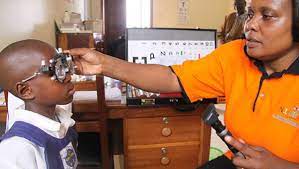
Addressing visual problems through screening using school teachers.
Visual problems continue to be detrimental to educational achievement especially when timely recognition of such health problem among community members. This has long-term consequences not only for the individual child, but also for society as educational and economic advancements are stifled. Few teachers understand how vision affects reading and learning. Several studies by Burnett. A.M., et al found that where the numbers of eye-care specialists are insufficient, training teachers in vision screening enables the provision of a good-quality and cost–effective service. When teachers learn about vision qualities and their impact on reading and learning, they understand why some students have reading difficulties, low motivation, low self-esteem, and difficulty concentrating. With these insights, Burnett. A.M., et al assure that more students can be assisted in reaching their full potential.
Successes and remaining challenges in eye care.
During the past 30 years, the World report on vision reveal significant concerted actions leading to remarkable many successes. This include (i) launching of global advocacy efforts; (ii) adoption of World Health Assembly resolutions; (iii) implementation of actions plans. Despite the recent scientific and technological developments promise to further accelerate these advances, progress is not keeping pace with population eye care needs, registering global challenges as eye care needs continue to rise sharply due to changes in demographics and lifestyle. Lack of data and weak health information systems continue to hamper strategic planning. Besides, poor integration of eye care into health systems and poor coordination of eye care workforce is still a challenge.
Why community-led monitoring for eye healthcare systems?.
Community-led monitoring approach trains, supports, equips, and pays members of directly affected communities to themselves carry out routine, ongoing monitoring of the quality and accessibility of services. Baptiste. S., et al (2020) remark on the role of CLM mechanisms in improving service delivery at facility-level, health system-wide infrastructure and health outcomes among recipients of care. Baptiste and colleagues reveal that proper identification and replication of successful CLM practices is a key pathway to equitable access to overall health services, which include eye health. Besides, the recent national eye health system assessment report recommends that local, national and international stakeholders to establish mechanisms for the regular monitoring of cataract surgery outcomes while developing new eye health initiatives, policies and projects. It is from this perspective, CLM Consultants recommends for strengthening eye healthcare systems through CLM approach.
Discover more from
Subscribe to get the latest posts sent to your email.
 clm-consultant.com